

10. The Setting
**The Setting - A Concept of Educational & Entrepreneurial Excellence by Prof. em. Dr. Jürgen Zimmer**
When the concept of a School for Life was to be realized for the first time in Bali in the second half of the nineties, at that time under the name of "National and International School Bali – NISBA", and in partnership with Bradley Gardner ("Begawan Giri") the commissioned architect Kwan Yew was urged to refrain from building anything that might look like a school, but rather to build an Open Learning Village. The realization of the project on 16 acres of land was slowed down by the Asian financial crisis in 1997, but the ideas of the Open Learning Village remained and became the basis of the master plan for the School for Life.
### 10\.1 Open Learning Village
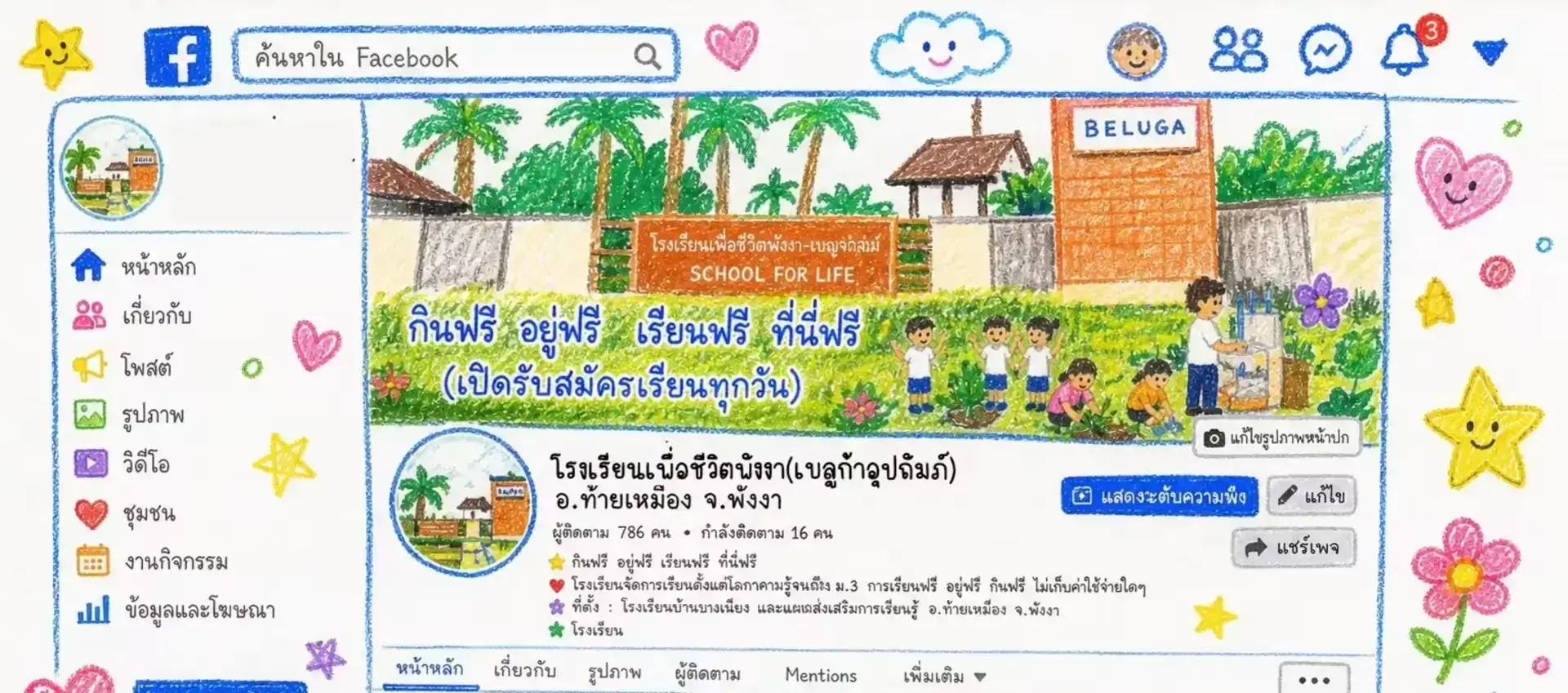
If you didn't see the sign at the entrance of the campus in Southern Thailand which says "School for Life", it wouldn't be obvious that it is (amongst other things) a school. It is a village with a number of areas: family houses, dormitories, Centers of Excellence, accommodation for guests, a restaurant, cafeteria, theater, sports facilities, the pavilion of religions, a school wing hidden behind the theater, but not one of the box-shaped conventional school buildings, and behind a plantation of rubber trees, the houses of the community, mainly those adults who survived the tsunami and moved onto the campus.
Many of the organizations are like optical illusions: the canteen is a canteen, the bakery is a bakery, but both are also places where learning takes place in the Center for Health & Nutrition. The guest bungalows, restaurant and reception area serve the guests and at the same time are the learning site of the Center for Culture Sensitive Tourism. With its theater, the Center for Cultural Heritage has a particularly dramatic character, as do all the Centers of Excellence. It would be foolish to design the Centers as classroom-like spaces. For teachers of the School for Life, the composition of the Open Learning Village acts as a daily invitation to free themselves from bondage to the curriculum and to use the learning opportunities of the village.
### 10\.2 The Masterplan of the village
## [Concept](https://phuketer.com/s/00000600/wiki/196/concept) Chapters
- **[1. Little History School for Life Chiang Mai](https://phuketer.com/s/00000600/wiki/210/1-little-history-school-for-life-chiang-mai)**
- **[2. At First Sight](https://phuketer.com/s/00000600/wiki/209/2-at-first-sight)**
- **[3. Characteristics](https://phuketer.com/s/00000600/wiki/208/3-characteristics)**
- **[4. The Family Concept](https://phuketer.com/s/00000600/wiki/207/4-the-family-concept)**
- **[5. Kindergarten](https://phuketer.com/s/00000600/wiki/206/5-kindergarten)**
- **[6. Schooling and Deschooling](https://phuketer.com/s/00000600/wiki/205/6-schooling-and-deschooling)**
- **[7. Learning Through Life](https://phuketer.com/s/00000600/wiki/204/7-learning-through-life)**
- **[8. The Seven Centers of Excellence](https://phuketer.com/s/00000600/wiki/203/8-the-seven-centers-of-excellence)**
- **[9. Think Tank and Master Workshops](https://phuketer.com/s/00000600/wiki/202/9-think-tank-and-master-workshops)**
- **[10. The Setting](https://phuketer.com/s/00000600/wiki/201/10-the-setting)**
- **[11. Teachers](https://phuketer.com/s/00000600/wiki/200/11-teachers)**
- **[12. Guests](https://phuketer.com/s/00000600/wiki/199/12-guests)**
- **[13. Partners](https://phuketer.com/s/00000600/wiki/198/13-partners)**
- **[14. Transfer of innovation](https://phuketer.com/s/00000600/wiki/197/14-transfer-of-innovation)**
- **[15 ](https://phuketer.com/s/00000600/wiki/196/concept#15.-attachments)[Source PDF (external site)](https://school-for-life.org/wp-content/uploads/2021/02/SfL-Konzept-2003-2016_fin-1.pdf)**
School for Life, 185/3 Moo 4, T. Pameing, Doi Saket District, 50220 Chiang Mai, Thailand Tel. +66 53 248194